
TX-6 vs K.O. Sidekick: Which Teenage Engineering Mixer for iPhone and iPad?
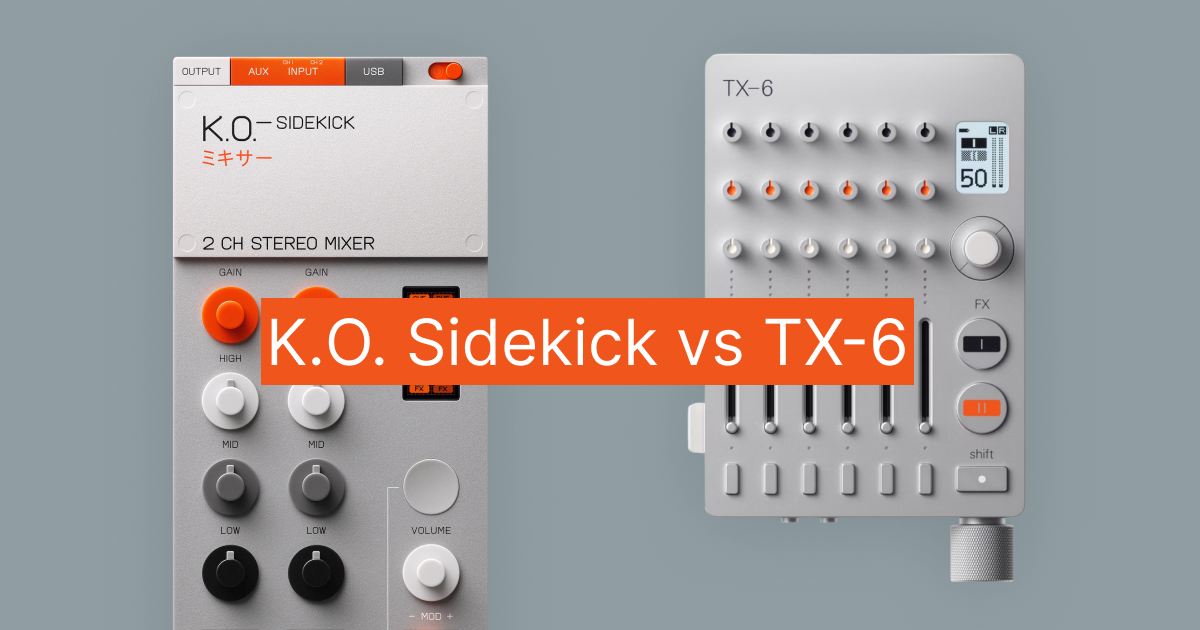
If you want to get several instruments into an iPhone or iPad, Teenage Engineering sells two obvious mixers, and they sit at wildly different prices. The TX-6 is around $1,199. The EP-136 K.O. Sidekick is $179. That gap looks absurd until you understand that they are not the same tool with a discount. They are built for different jobs. We make a recorder for iPhone, so we spend a lot of time thinking about how gear feeds into a phone, and this is the honest breakdown of which one is right for you.
The short answer
For most people building an iPhone or iPad setup, the $179 K.O. Sidekick is the smarter buy. It gets several devices into iOS, has genuinely playable effects and controls you can actually grab, and costs a seventh of the TX-6.
The $1,199 TX-6 earns its price only if you need six clean channels, want it as the clock master of a bigger rig, are building around a TP-7 recorder, or gig often enough that one machined-aluminium box beats juggling several plastic ones. Both do the core job of summing your gear into the single audio interface that iOS allows. You are paying the TX-6 premium for scale, build and system role, not for better mixing tools.
What they share
It is worth starting here, because the cheap one is not missing the basics. Both the TX-6 and the K.O. Sidekick are class-compliant USB mixers and audio interfaces, so both plug straight into an iPhone or iPad with no drivers and no fuss. Both give every channel a three-band EQ and a compressor. Both can multitrack into iOS rather than only sending a stereo mix. On the fundamentals they are far closer than the price suggests.
Where the TX-6 pulls ahead
Scale and role are the TX-6's real advantages. It has six stereo channels and presents up to twelve of them to a Mac or iOS device as separate tracks, where the Sidekick tops out around six mono channels. Two things about that twelve-channel mode are worth knowing before you rely on it. The streams are post-fader, which Teenage Engineering states plainly, so the faders you ride for the room are also setting your recording levels: pull one down to fix the balance in your ears and you gut that track in the DAW. And in twelve-channel mode you get the six strips instead of the master mix, not as well as it, so if you want a stereo bounce alongside your stems you need a second recorder or a second pass. Its body is machined aluminium, genuinely premium and built to survive years on the road. It has beat tracking, meaning it can read the tempo of an incoming signal and send matched clock out to the rest of your gear, which makes it a true hub rather than just a mixer.
It is also part of the Field system. Pair it with a TP-7 recorder and the TP-7's individual tracks route into the TX-6 for live mixing with per-track effects, then bounce back down to the TP-7 as a finished stereo master. If you are building a serious portable multitrack rig, that integration is the reason people choose it.
The catch is the knobs, and it is a real one. The TX-6's controls are famously tiny. Unless you have slim fingers, adjusting one without nudging its neighbour is a genuine fiddle, and plenty of reviewers have called them cramped. You are buying a beautiful, capable object that is slightly awkward to operate in the moment.
Where the K.O. Sidekick wins
The Sidekick trades the premium build for practicality, and for a lot of people that is the better deal. It is plastic and light, the faders feel a little delicate and the knobs could grip better, but the controls are bigger and far easier to grab and twist while you play. It costs $179.
It also expands. Snap several together with the EP Pegs connectors when you need more channels, and it physically clips onto an EP-133 K.O. II, so two samplers around a Sidekick make a tidy little DJ rig. For a bedroom or mobile setup it does the job you actually need at a fraction of the price.
The effects, compared
The effects are where the two really diverge, and it is not a case of better or worse. They are different species. The TX-6 gives you two effects slots aimed at sweetening a mix: the first is a global send carrying chorus, reverb or delay, and the second is an insert offering tremolo, freeze, tape, filter or distortion on one track or the whole mix. Note the word global, and note or rather than and. You get one engine per slot, so there is effectively a single reverb-or-delay-or-chorus for the entire mixer rather than per-channel effects. Per-channel you do get EQ, a filter and a compressor, always available.
The Sidekick gives you six performance effects you play by hand, driven by a little modulation stick and a pressure pad, with a tap sequencer for triggering them in rhythm: a filter that sweeps from low-pass to high-pass, a tempo-synced delay, a tape scratch and stop, a beat-repeat loop, a tremolo and a dub siren. Its EQ even switches between DJ, parametric and studio modes.
So the TX-6's effects are for mixing. The Sidekick's are for performing. Which set you want depends entirely on whether you are finishing a mix or playing a set.
So do three Sidekicks beat one TX-6?
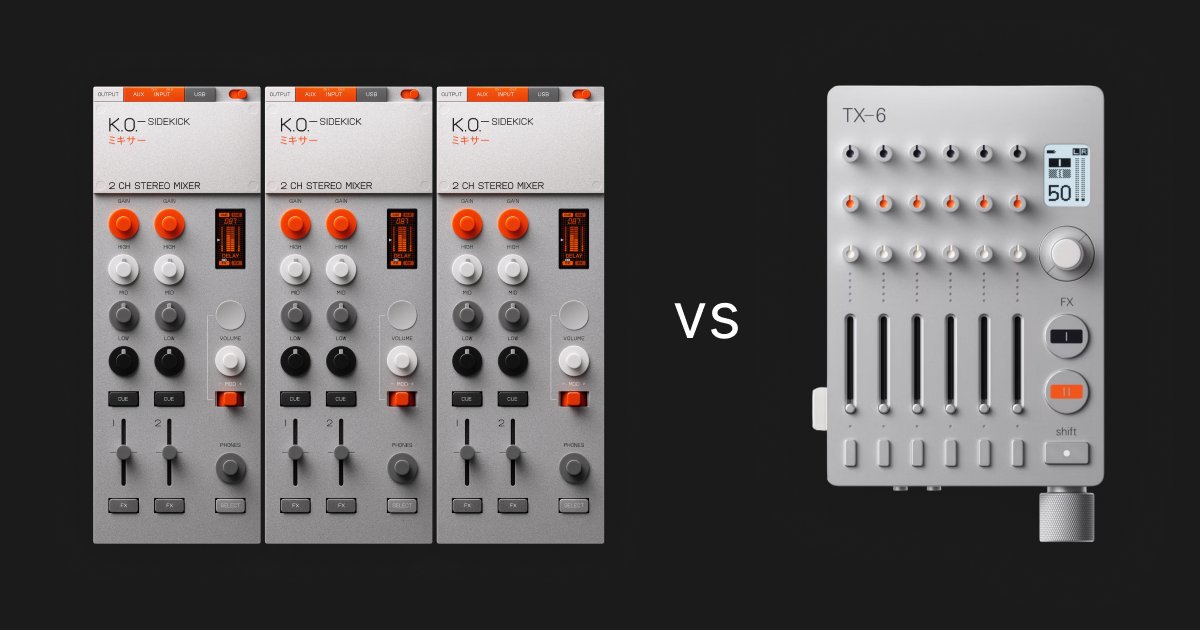
This is the question people really ask, so here is the straight answer. Three Sidekicks cost under $600, less than half a TX-6, and give you a similar total channel count. On price and channels alone they win easily.
What the maths leaves out is everything around the channels. With three units you are managing three boxes, cascade cables between them and a fistful of batteries, and because iOS only allows one audio interface at a time, only one Sidekick can be the interface into your iPad while the others feed it through their outputs. You also get no single twelve-channel feed, no TP-7 integration and no clock mastering. In return you get three sets of those playable performance effects, which for a performer is a genuine plus. Cheaper and more modular, yes. Cleaner and more capable as one hub, no. Pick the trade that matches how you work rather than the one that wins a spreadsheet.
The scorecard
The quick version, side by side.
- Price: TX-6 around $1,199, K.O. Sidekick $179.
- Channels: TX-6 has six stereo channels and a twelve-channel interface; the Sidekick has two stereo channels plus an aux and an eight-in, four-out interface, and chains for more.
- Per-channel EQ and compressor: both have them; the Sidekick's EQ adds DJ, parametric and studio modes.
- Effects: TX-6 studio-style processors for mixing; Sidekick playable performance effects for gigging.
- Build: TX-6 machined aluminium, premium but with tiny cramped knobs; Sidekick plastic and light, delicate faders but bigger, easier controls.
- System role: TX-6 integrates with the TP-7 and acts as a clock master; the Sidekick pairs with the EP-133 K.O. II via EP Pegs.
So which should you buy?
It comes down to what you are building.
- Buy the K.O. Sidekick if you want a small dawless jam recorded into your phone, a DJ or performance rig with samplers, or simply the cheapest honest way to get several devices into an iPad. For most people this is the answer.
- Buy the TX-6 if you need six clean channels in one bombproof box, want it as the clock master for a bigger rig, are building around a TP-7, or gig often enough that one integrated aluminium tool beats carrying several.
Where the recording happens
Whichever you choose, remember why you are buying it. iOS only accepts one audio interface at a time, so the mixer's core job is to sum everything into that one interface. Once it does, a recorder on your phone catches the result. Reel, the four-track recorder we make, takes the summed USB output of either mixer straight into a clean 32-bit float recording, so nothing clips when the jam gets loud. The traffic runs both ways now, which changes what a mixer is for here. Reel sends its four stereo tracks plus its own stereo master back down the same USB cable, ten channels in total, and a TX-6 receives them across five of its six stereo channel strips. So the four parts you recorded arrive on their own faders and you mix them live on the hardware. The mixer stops being the thing that feeds the phone and becomes the thing you mix the phone on. That is worth weighing at this price, because it is the TX-6 that has the channel count to take the whole thing back. For the full picture of wiring a multi-device setup into iOS, there is a longer guide on connecting multiple devices to an iPhone or iPad.
Frequently Asked Questions
Is the TX-6 or K.O. Sidekick better for an iPhone or iPad?
For most iPhone and iPad setups the $179 K.O. Sidekick is the smarter buy: it gets several devices into iOS, has playable effects and bigger, easier knobs. The $1,199 TX-6 is worth it if you need six clean channels, want it as a clock master for a bigger rig, are building around a TP-7, or gig often and want one machined-aluminium box.
Can I use three K.O. Sidekicks instead of one TX-6?
You can, and it costs under half as much for a similar channel count. The trade-off is three boxes, cascade cables and more batteries, with only one acting as the USB audio interface into iOS, and none of the TX-6's single twelve-channel feed, TP-7 integration or clock mastering. It is the cheaper, more modular path rather than a straight replacement.
Does the K.O. Sidekick work with the TP-7 like the TX-6 does?
Not in the same integrated way. The TX-6 is part of the Field system and pairs with the TP-7 for a record, live-mix and bounce workflow. The K.O. Sidekick belongs to the EP line and snaps onto the EP-133 K.O. II via EP Pegs connectors. You can route its audio anywhere, but the TP-7 multitrack integration is a TX-6 feature.
What is the difference between the TX-6 and K.O. Sidekick effects?
The TX-6 has two studio-style effects processors (reverb, chorus, delay, freeze, tape, filter, distortion) built to sweeten a mix. The Sidekick has six performance effects (filter, delay, tape, loop, tremolo, siren) driven by a stick and pressure pad for playing live. One set is for mixing, the other for performing.
Do both work as a USB audio interface on iOS?
Yes. Both are class-compliant, so both plug into an iPhone or iPad with no drivers. The TX-6 presents up to twelve channels, the Sidekick eight in and four out. Since iOS uses only one audio interface at a time, either one becomes the single interface that sums your gear into the phone.
Related guides
- Connecting Multiple Devices to an iPhone or iPad: Hubs, Mixers, Sync and the One-Interface Rule →
- How to Record a Dawless Setup on iPhone →
- Best iOS Apps for a Dawless Setup (2026) →
- Recording with OP-1 Field and iPhone →
- Best USB Audio Interfaces for iPhone Recording in 2026 →
- Reel vs OP-1 Field →
- How to Record an EP-133 K.O. II into Your iPhone →
- How to Mix Your iPhone Multitrack on a TX-6 →
More from the blog
TP-7 File Transfer to iPhone: MTP Without a Computer
Getting recordings off a Teenage Engineering TP-7 has always meant a computer. It does not any more. TP-7 MTP file transfer straight to an iPhone, multitrack takes staying multitrack, six-track takes included, and takes going back to the device. Coming soon to Reel.
MTP on iOS: We Got the OP-1 Field, OP-XY and TP-7 Talking to an iPhone
MTP on iOS was supposed to be impossible. It is not. Move recordings between an iPhone and an OP-1 Field, an OP-XY or a TP-7 with no computer in the middle. Tapes come across as separate tracks, single tracks lift into other songs and everything can be sent back to the device. Coming to Reel.
Author
Tug
Founder of 24bit Studio and the developer of Reel, a portable 4-track recorder for iPhone.