
What Is a 4-Track Recorder? (And Why People Still Use One)
A four-track recorder is one of those tools people mention constantly without ever quite defining. If you have landed here because a song credit, a gear forum or an app said four-track and you wanted to know what that actually means, this is the short, honest answer. We build a four-track ourselves, so we have skin in the game, but the definition below is the plain one, and it holds whether the machine is a tape deck from 1979 or the phone in your hand.
The short version
A four-track recorder lets you record four separate audio tracks and play them back together as one piece of music. The key word is separate. Each track is its own independent lane of sound, so you can record a guitar on track one, a vocal on track two, a bass on track three and a tambourine on track four, then set the volume, the balance and the effects of each one on its own before mixing them into a finished recording.
That is the whole idea. Instead of capturing a live performance in a single stereo photograph, a four-track lets you build a song a layer at a time and keep control of each layer. It is the smallest machine that still counts as a real multitrack recorder, and for a lot of people it is the perfect size.
What a track actually is
A track is one lane of recorded audio that you can handle by itself. A voice memo has one track: everything the microphone hears, mixed together, with no way to pull the guitar down or push the vocal up afterwards. A four-track gives you four of those lanes running in parallel, recorded at different times if you like, and kept separate until you decide to combine them.
That separation is the entire point of multitracking. Because the parts live on their own lanes, you can rerecord the vocal without touching the drums, mute the bass to hear the guitar alone, or pan one part left and another right. Four lanes is enough to hold the bones of most songs: rhythm, bass, a lead and a vocal, or any four things you want to balance against each other.
Where the name comes from
The term comes from tape. Professional studios recorded onto wide reels of tape divided into parallel strips, and a machine that used four of those strips was a four-track. Sgt. Pepper's Lonely Hearts Club Band was made this way, on four-track machines, by bouncing parts down to free up room and overdubbing more on top.
The format reached bedrooms in 1979, when Tascam released the Portastudio and put four-track recording onto an ordinary cassette. A normal cassette already holds four tracks on the tape, two for each side in stereo, and the trick of the Portastudio was to use all four in one direction at once, often running the tape at double speed for better fidelity. Suddenly a musician could multitrack at home for the price of a stereo, and a whole era of demos and lo-fi records followed. If you want that story in full, it is worth reading how the cassette four-track changed home recording.
How you record more than four parts
The obvious question is what happens when a song needs more than four things. The answer is a technique called bouncing, sometimes called ping-ponging. You fill your four tracks, mix them down onto a single track, and that frees the other three for new parts. Do it again and you can stack a whole arrangement well beyond four sounds.
The catch, and it is really a feature, is that each bounce commits the mix you made: the levels, the balance, the effects, more or less for good. You decide, you print it, you keep building. The phones do this too. Reel calls it Resample: you print the master output straight back onto one of the four tracks, the same commit-and-carry-on move, without a generation of tape hiss for the trouble. That is exactly how those four-track records held far more than four sounds, and it is why working on four teaches you to commit instead of endlessly tinkering. There is a longer case for that constraint in why four tracks is enough.
Why people still use one
In an age of computer recording with unlimited tracks, a four-track can look like a step backwards. It is not. The limit is the reason people reach for it. Four lanes force you to arrange, to choose what matters and to finish, where an open-ended session invites you to keep adding layers and never call anything done.
There is also the feel. A four-track is usually a hands-on box with real transport buttons and a simple layout, not a maze of menus. You hit record, you play, you move on. For catching an idea before it evaporates, that immediacy beats a full studio every time, which is why the format keeps coming back rather than dying off.
The 4-track today: from cassette to your iPhone
You do not need a dusty cassette machine to work this way now. The four-track has moved onto the phone in your pocket, and that is the version most people meet first today. A modern four-track app records four tracks in clean 32-bit float instead of hissy tape, takes input from USB microphones and instruments, and still keeps the overdub, punch-in and bounce workflow the old machines were built around.
That is what Reel is: a four-track recorder for iPhone, built around a spinning disc you scrub with your thumb, made for catching ideas the moment they arrive. If you want to see how the format translates to a phone, start with using your iPhone as a 4-track recorder, or compare the current options in the best 4-track recorder apps for iPhone.
See a 4-track in action
Here is a quick look at a four-track that lives on a phone.
Image credit
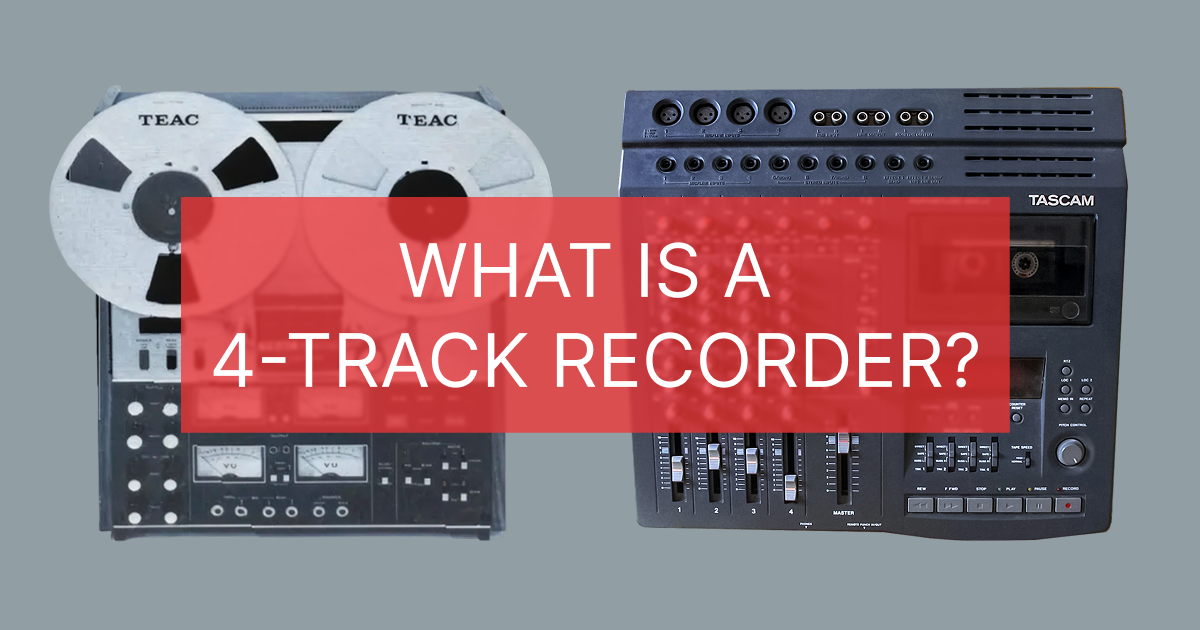
The image at the top of this article was made from two photographs: a TEAC 2340 reel-to-reel by Bubba73, licensed CC BY 2.5 (creativecommons.org/licenses/by/2.5), and a Tascam Portastudio 424 MKII by Lucius Kwok, licensed CC BY-SA 2.0 (creativecommons.org/licenses/by-sa/2.0). Both were cropped and combined and a title was added. This adaptation is shared under CC BY-SA 2.0.
Frequently Asked Questions
What does 4-track mean?
It means a recorder that captures four separate audio tracks you can control independently. You might record a vocal on one, a guitar on another, and so on, then balance and mix all four into a finished song rather than capturing everything in one live take.
What is a track in recording?
A track is a single independent lane of recorded audio. Keeping parts on separate tracks lets you rerecord, mute, pan or adjust one without affecting the others, which is the whole point of multitrack recording.
How do you record more than four parts on a 4-track?
By bouncing, also called ping-ponging. You fill your four tracks, mix them down onto one to free the others, and overdub more parts on top. Each bounce commits that mix, which is how four-track records stacked far more than four sounds.
Is a 4-track recorder still useful?
Yes. The four-track limit forces you to arrange and finish rather than endlessly adding layers, and the hands-on workflow is fast for capturing ideas. For sketching songs, cutting demos and layering loops, four tracks is plenty.
Can my phone be a 4-track recorder?
Yes. Apps like Reel turn an iPhone into a four-track recorder with 32-bit float audio, USB microphone and instrument input, and the same overdub and bounce workflow as the classic cassette machines, without the tape hiss.
Related guides
More from the blog
TP-7 File Transfer to iPhone: MTP Without a Computer
Getting recordings off a Teenage Engineering TP-7 has always meant a computer. It does not any more. TP-7 MTP file transfer straight to an iPhone, multitrack takes staying multitrack, six-track takes included, and takes going back to the device. Coming soon to Reel.
MTP on iOS: We Got the OP-1 Field, OP-XY and TP-7 Talking to an iPhone
MTP on iOS was supposed to be impossible. It is not. Move recordings between an iPhone and an OP-1 Field, an OP-XY or a TP-7 with no computer in the middle. Tapes come across as separate tracks, single tracks lift into other songs and everything can be sent back to the device. Coming to Reel.
Author
Tug
Founder of 24bit Studio and the developer of Reel, a portable 4-track recorder for iPhone.